There’s a specific moment in “Red Dead Redemption 2” that I think about often. I was riding through Valentine when I accidentally bumped into a man carrying groceries. He dropped everything, cursed at me, and walked off muttering. Three in-game days later, I spotted him at the saloon. He recognized Arthur, made a snide comment about careless riders, and refused to acknowledge me for the rest of that visit.
Nobody scripted that sequence for me specifically. The game simply remembered, and the NPC behaved accordingly.
That’s intelligent NPC design at its finest—and it’s reshaping what we expect from video game worlds.
Beyond Walking Dialogue Boxes
For decades, non-player characters existed as little more than quest dispensers and atmosphere fillers. They’d repeat identical lines forever, walk predetermined paths, and treat every player interaction as if it happened in complete isolation from everything before.
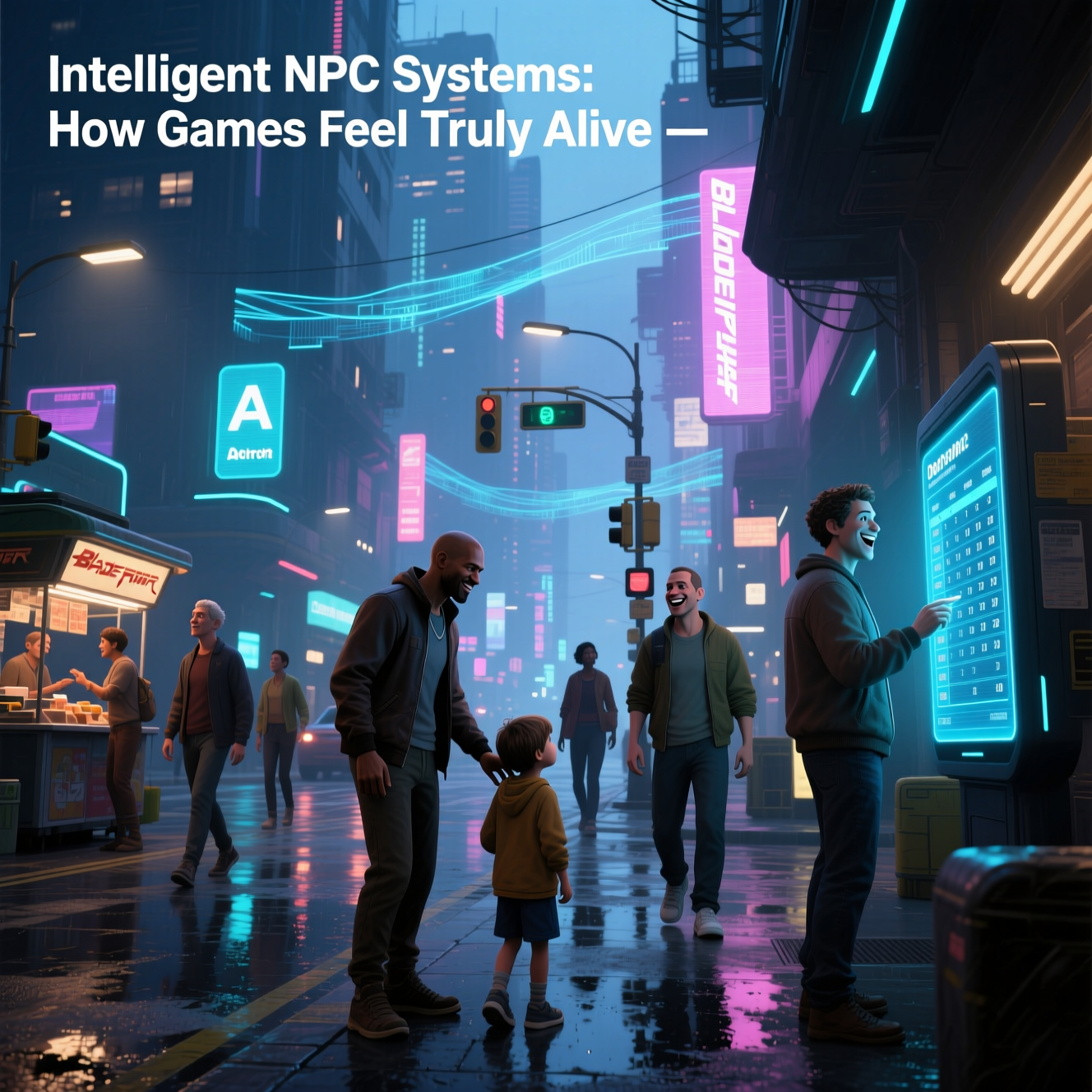
Intelligent NPC systems fundamentally change this paradigm. These systems give characters memory, schedules, emotional states, and the ability to respond contextually to player actions and world events. They transform static populations into dynamic communities that feel genuinely inhabited.
The difference becomes obvious once you’ve experienced it. Going back to games with traditional NPCs afterward feels hollow, like visiting a theme park where all the employees are animatronic.
The Building Blocks of NPC Intelligence
Modern intelligent NPC systems typically combine several interconnected components.
Behavioral State Machines form the foundation. Rather than following simple scripts, NPCs transition between states based on internal and external factors. A shopkeeper might switch from “working” to “anxious” to “fleeing” depending on threats, time of day, or previous player interactions.
Memory Systems track significant events. Did the player help this NPC before? Threaten them? Ignore their requests? Smart systems store these interactions and reference them during future encounters. Some games use reputation networks where NPCs share information about player behavior, creating genuine consequences for your choices.
Schedule and Routine Systems make characters feel like they exist beyond player observation. The blacksmith closes shop at dusk, walks to the tavern, eats dinner, then heads home. This continues whether you’re watching or not. Games like “The Elder Scrolls” series pioneered this approach, though Oblivion’s implementation became notorious for unintended hilarity—NPCs having bizarre conversations about mudcrabs at dinner parties.
Relationship Networks connect characters to each other. Hurt one NPC, and their family members, friends, or faction allies respond accordingly. These webs create cascading consequences that make worlds feel genuinely interconnected.
Standout Examples Worth Studying
Several games have pushed NPC intelligence in remarkable directions.
The Witcher 3: Wild Hunt features NPCs with survival instincts and contextual awareness. Villagers comment on Geralt’s actions, react to monster corpses, and remember significant quests long after completion. The game’s branching narratives mean NPC fates change dramatically based on player choices, sometimes in ways you don’t discover until dozens of hours later.
Dwarf Fortress takes a radically different approach. Every character possesses procedurally generated personalities, relationships, memories, and life histories. Dwarves develop grudges, form friendships, experience trauma, and make decisions based on complex psychological profiles. The results can be chaotic—sometimes tragically so—but the depth remains unmatched.
Cyberpunk 2077 struggled at launch but has since improved substantially. Night City’s crowds now respond more believably to violence, recognize V based on street credibility, and maintain somewhat consistent daily patterns. It’s not perfect, but the improvements between launch and current versions demonstrate how complex NPC behavior truly is to implement correctly.
Stardew Valley proves that intelligent NPCs don’t require massive budgets. Each villager follows unique schedules, remembers gift preferences, develops relationships over time, and reveals backstory gradually. The simplicity works precisely because expectations match the game’s scale and style.
Why This Matters for Immersion

Here’s something I’ve noticed after years of playing and analyzing games: intelligent NPC behavior disproportionately affects immersion compared to graphics or even story quality.
You can forgive slightly dated visuals. You can overlook occasional plot holes. But when an NPC acts stupidly—ignoring obvious threats, forgetting major events, or breaking logical consistency—it shatters the illusion immediately.
Our brains are remarkably tuned to detect social abnormalities. We evolved reading faces and predicting behavior for survival. When NPCs violate expected social rules, something registers as deeply wrong, even if players can’t articulate exactly what.
Intelligent systems prevent these immersion breaks by ensuring characters respond appropriately to context. They don’t achieve human-level behavior, obviously, but they avoid the most egregious failures that pull players out of experiences.
The Challenges Developers Face
Building these systems isn’t straightforward, and limitations deserve honest acknowledgment.
Performance constraints remain significant. Tracking detailed states for hundreds or thousands of NPCs simultaneously taxes hardware. Developers constantly balance depth against scale, sometimes sacrificing one for the other.
Debugging complexity increases exponentially. When NPCs follow rigid scripts, problems are easily identified. When they respond dynamically to numerous variables, tracking down weird behaviors becomes nightmarish. I’ve spoken with QA testers who spent weeks chasing single NPC bugs through interconnected systems.
Player expectations create moving targets. Each improvement raises the bar. Features that seemed magical five years ago now feel standard, and audiences notice when games fall short of current leaders.
Writing demands multiply. Dynamic NPCs need dialogue variations for countless situations. Writing budgets balloon, and quality control across thousands of lines becomes challenging.
Looking Forward
The trajectory seems clear. NPCs will continue growing more sophisticated as technology improves and player expectations rise.
Procedural personality generation—characters created dynamically rather than hand-crafted—offers scalability that traditional approaches can’t match. Combined with improved behavioral modeling, future games might populate entire worlds with genuinely unique inhabitants.
Whether this enhances or diminishes game experiences remains debatable. Sometimes limitations force creative focus. An unforgettable hand-crafted character might resonate more than a thousand procedurally adequate ones.
The sweet spot probably involves hybrid approaches—procedural populations with hand-crafted key figures. We’re already seeing this in many open-world titles.
Final Thoughts
Intelligent NPC systems represent gaming’s quiet revolution. They don’t make trailers or dominate marketing materials. Yet they fundamentally determine whether virtual worlds feel alive or hollow.
The best implementations remain invisible. You shouldn’t notice NPCs being intelligent—you should simply accept them as believable inhabitants of their worlds. That seamlessness is exactly what makes the technology so impressive when done right.
FAQs
What are intelligent NPC systems?
These are game systems that give non-player characters memory, schedules, emotional states, and the ability to respond dynamically to player actions and world events.
Which games have the best NPC systems?
Red Dead Redemption 2, The Witcher 3, Dwarf Fortress, and Stardew Valley are frequently praised for NPC behavior quality.
Do intelligent NPCs use machine learning?
Most current implementations use state machines and rule-based systems rather than true machine learning, though some experimental projects explore learning-based approaches.
Why do NPCs sometimes act strangely?
Complex interconnected systems create edge cases developers didn’t anticipate. Debugging these emergent behaviors proves difficult in dynamic environments.
Do better NPCs require better hardware?
Generally yes. Tracking numerous character states simultaneously demands processing power, which is why console generations often coincide with NPC behavior improvements.
How do NPCs remember player actions?
Games use database systems that store significant events, player choices, and interaction histories, then reference these during future NPC encounters.