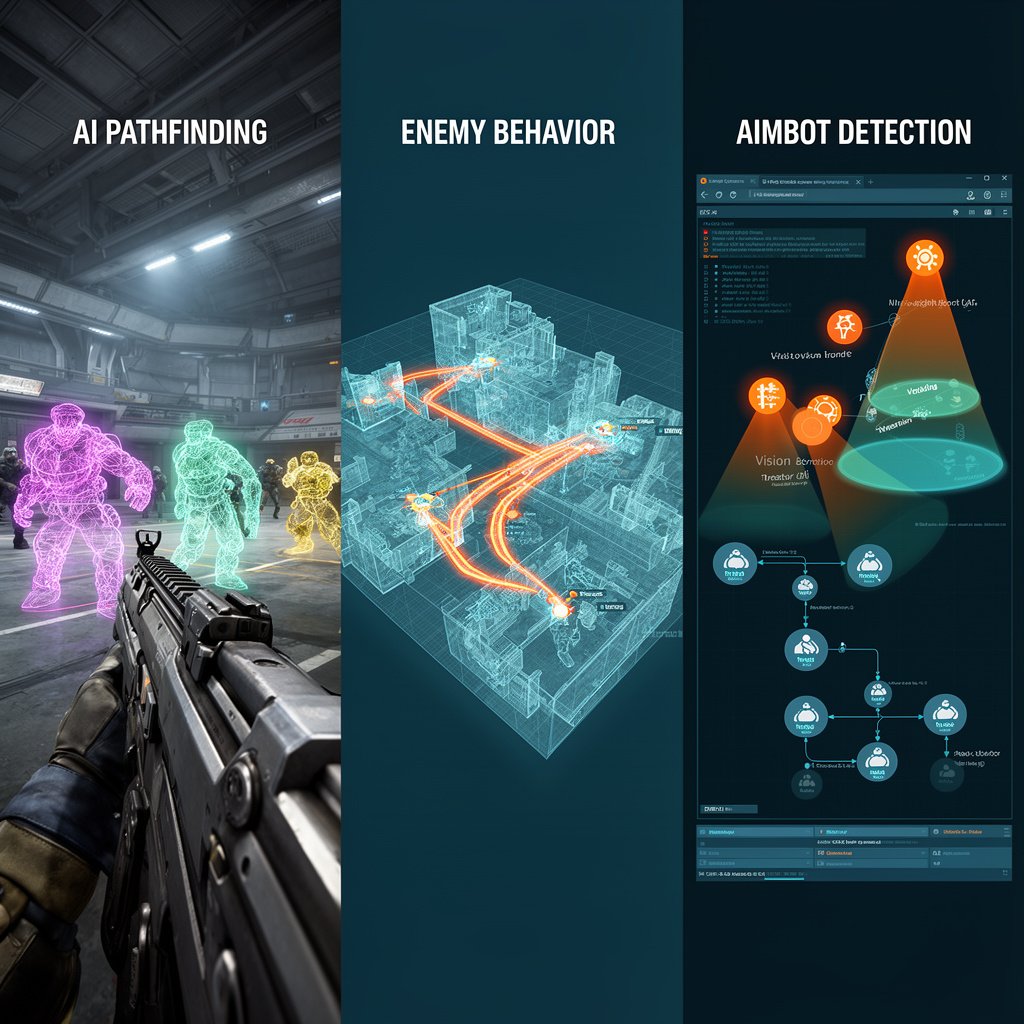
The first time I truly noticed enemy AI was during a firefight in F.E.A.R. back in 2005. I’d tossed a grenade into a room expecting easy kills, but instead watched soldiers dive through windows, flank my position, and coordinate a counterattack that left me genuinely panicked. These weren’t scripted sequences. The enemies had outthought me.
That experience fundamentally changed how I evaluated first-person shooters. Graphics age, storylines get forgotten, but intelligent enemies create moments you remember for decades. And yet, crafting believable AI opponents remains one of game development’s most underappreciated challenges.
Why FPS AI Is Uniquely Difficult
Creating enemies for first-person shooters presents problems that other genres don’t face as intensely.
The perspective matters enormously. In strategy games or third-person titles, players observe AI from a distance. Flaws become less noticeable. But first-person shooters put you inches from your opponents. You watch them react or fail to react in real time. Every hesitation, every bizarre decision, every navigational failure happens right in front of your face.
Speed compounds everything. FPS combat unfolds in seconds, not minutes. AI must make split-second decisions about cover, positioning, target prioritization, and weapon selection. Too slow and enemies feel brain-dead. Too fast and they seem mechanical, robotic, inhuman.
There’s also the balance problem. AI that actually played optimally would devastate human players. Perfect aim, instant reactions, total map awareness computers can easily outperform human reflexes. So developers must handicap AI while maintaining the illusion of competence. It’s like choreographing a boxing match where one fighter could win instantly but must pretend otherwise.
The Building Blocks of Shooter AI
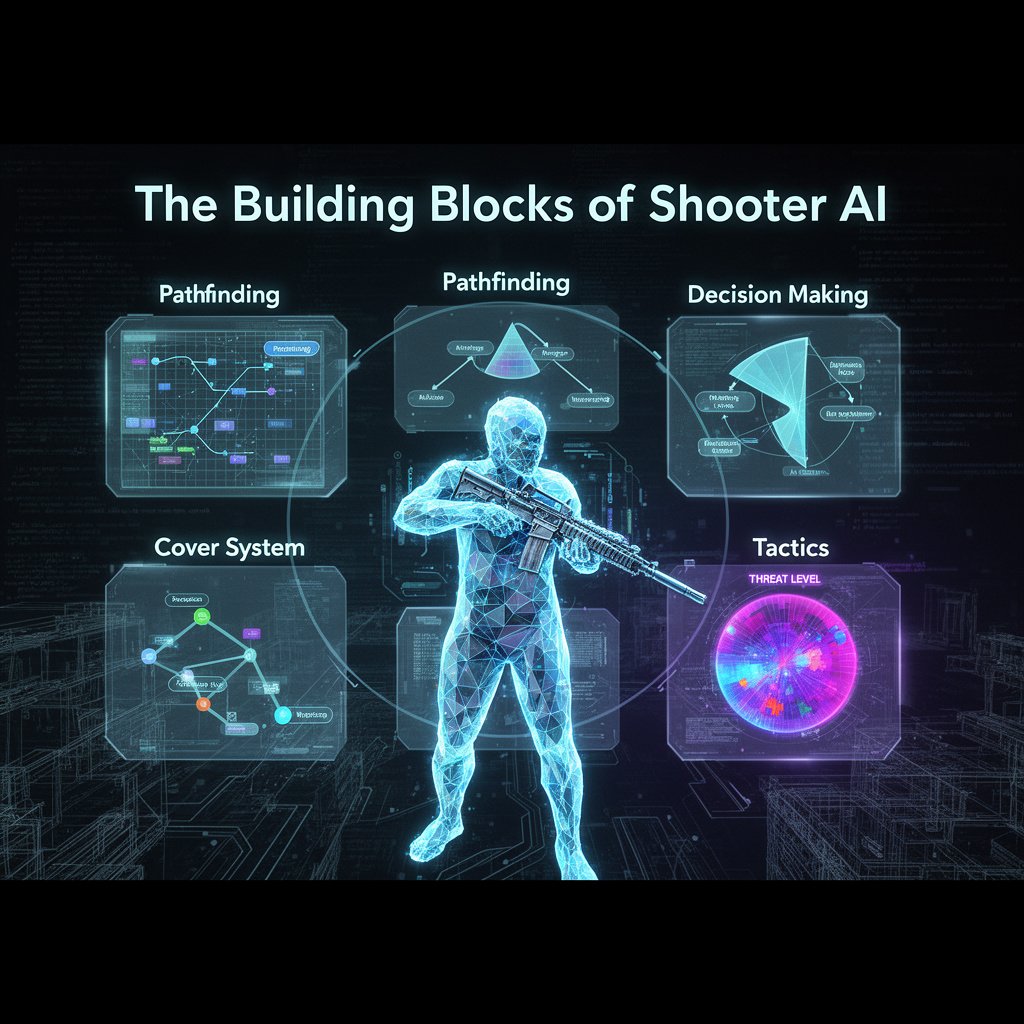
Most FPS enemy AI relies on several interconnected systems working together.
Perception systems determine what enemies can see, hear, and know about. Modern games simulate vision cones, hearing ranges, and attention states. An enemy might hear your footsteps, become alert, investigate the sound source, then return to patrol if nothing appears. These graduated awareness states create tension and reward stealth play.
Navigation meshes allow enemies to move through environments intelligently. The game world gets mapped into traversable regions, with AI calculating paths between points while considering obstacles, cover positions, and hazards. When this works well, it’s invisible. When it fails, you see enemies running into walls or standing motionless in doorways.
Behavior trees govern decision-making under pressure. These systems evaluate conditions and select appropriate responses. Low health? Retreat to cover. Player reloading? Push aggressively. Ally down? Provide suppressing fire. The complexity of these trees largely determines how smart enemies feel.
Squad coordination adds another layer. Individual enemy intelligence matters less if soldiers don’t work together. Games like Ghost Recon and Rainbow Six simulate communication between AI teammates, allowing flanking maneuvers, suppression tactics, and coordinated breaches.
Landmark Games That Pushed Boundaries
Certain titles advanced FPS AI in ways that influenced everything after.
F.E.A.R. remains the gold standard nearly two decades later. Monolith Productions implemented a planning system where enemies evaluated multiple tactical options simultaneously. They’d call out player positions, coordinate movements, use grenades to flush you from cover, and retreat when outgunned. Watching recordings of AI behavior still impresses developers today.
Halo: Combat Evolved brought personality to enemy types. Grunts panicked without Elite leadership. Elites fought tactically and used cover intelligently. Hunters worked in devastating pairs. Each species required different approaches, creating variety through AI design rather than just weapon loadouts.
The original Half-Life introduced enemies that seemed to communicate. Marines would shout commands, throw grenades to dislodge players, and advance in squads. Much of this was smoke and mirrors barks triggered independently from actual AI decisions but the illusion worked brilliantly.
Far Cry established open-world shooter AI that operated without scripted encounters. Enemies patrolled territories, investigated disturbances, and responded to environmental threats alongside player actions. This systemic approach influenced countless games afterward.
The Limitations Nobody Talks About
Let’s be honest about where FPS AI still struggles.
Memory remains frustratingly short. Kill an enemy’s partner, hide for thirty seconds, and survivors often forget the engagement entirely. This artificial amnesia exists for gameplay reasons permanent alert states would frustrate players but it shatters believability.
Friendly AI in single player campaigns is frequently terrible. How many times have squadmates blocked doorways, walked into your line of fire, or died to obvious threats? Ally AI must avoid overshadowing players while remaining useful, a nearly impossible balance most games fail.
Predictability creeps in after enough playtime. Once you understand enemy patterns, even sophisticated AI becomes exploitable. The patrol routes, the cover preferences, the reload timings everything becomes readable. Developers combat this with randomization, but truly unpredictable AI often feels unfair rather than challenging.
Difficulty scaling often means cheating. Higher difficulty levels frequently just increase enemy damage and health while decreasing player resources. Genuinely smarter AI at harder difficulties remains rare because developing multiple intelligence tiers multiplies workload exponentially.
Modern Developments Worth Watching
Recent years have brought interesting innovations.
Machine learning experiments allow AI to adapt to individual player tendencies. If you always peek from the same corners, enemies could theoretically learn to prefire those positions. Implementation remains limited but promising.
Better pathfinding through destructible environments lets enemies navigate spaces that change mid-combat. Blow a hole in a wall and AI recalculates routes incorporating new options. This creates dynamic encounters where environment manipulation affects tactical possibilities.
Improved teammate AI in cooperative shooters finally makes bots viable substitutes for absent players. Games like Left 4 Dead 2 and more recent titles feature companion AI that genuinely contributes rather than constantly requiring rescue.
Emotional state modeling adds believability to enemy behavior. Fear, anger, desperation these emotional factors now influence decision making in some titles. Wounded enemies might surrender or fight with reckless aggression depending on personality variables.
Finding The Sweet Spot
Great FPS AI isn’t about maximum intelligence. It’s about creating opponents that challenge players appropriately while feeling believable and fair.
The best enemies make you feel clever when you defeat them. They should seem dangerous, reactive, and coordinated but not omniscient or superhuman. Victory should feel earned, not given.
That F.E.A.R. firefight worked because the AI created an experience where I felt outmaneuvered by thinking opponents. When I finally cleared that room, I’d genuinely outsmarted them. That emotional payoff the satisfaction of tactical victory is what excellent FPS AI delivers.
And honestly? We’re still chasing that benchmark nearly twenty years later.
Frequently Asked Questions
What makes FPS AI different from other game AI?
The first person perspective magnifies AI flaws, and split second combat demands faster decision-making than most genres require.
Which FPS game has the best enemy AI?
F.E.A.R. is widely considered the benchmark, though Halo and Metro series also receive consistent praise for intelligent enemy behavior.
Why does friendly AI often perform poorly?
Ally AI must avoid overshadowing players or stealing kills while remaining useful—an extremely difficult design balance.
Do higher difficulty settings make AI smarter?
Rarely. Most games increase enemy damage and health rather than improving actual intelligence, though some titles implement genuinely smarter behavior at higher difficulties.
Can AI enemies learn from player behavior?
Some modern games experiment with adaptive AI, but widespread implementation remains limited due to technical complexity.
Why do enemies forget about me so quickly?
Permanent alert states would make games frustrating. Short memory exists as a gameplay compromise, even though it reduces realism.