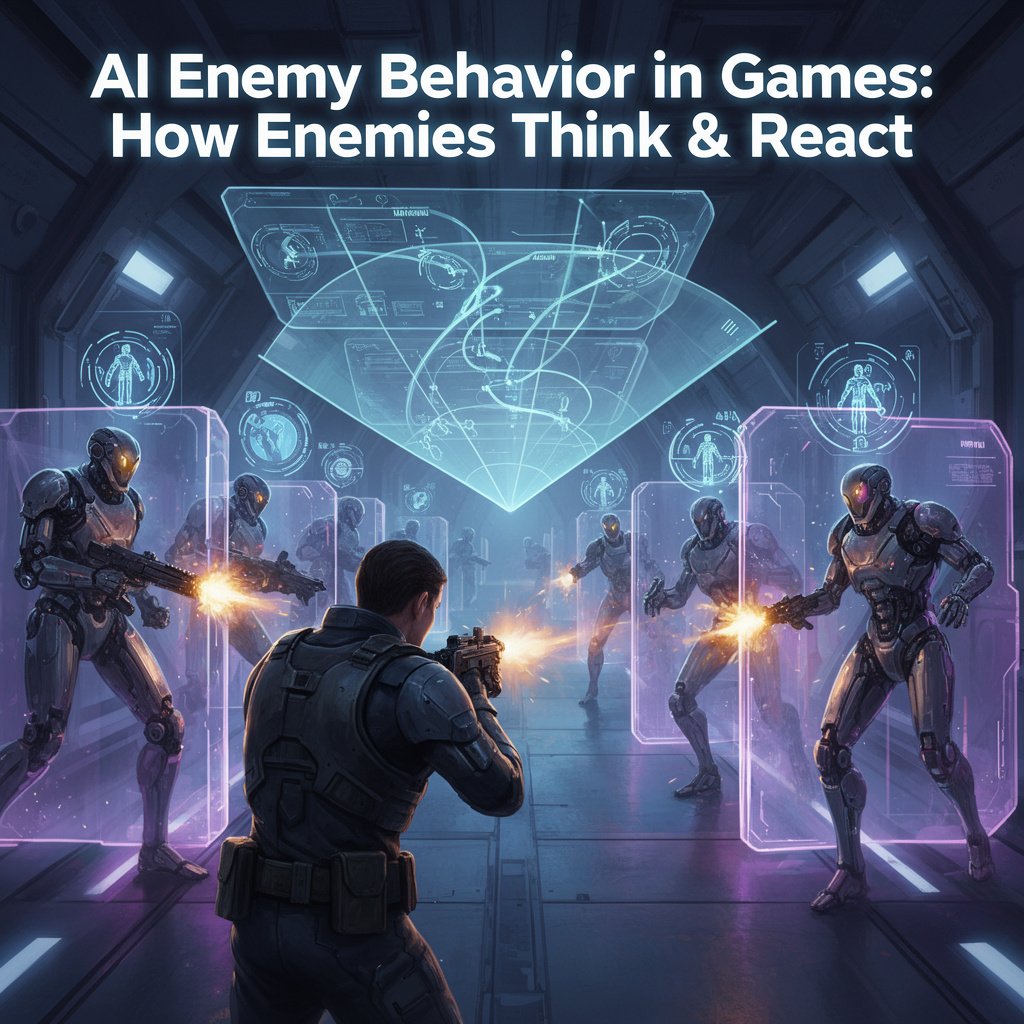
There’s nothing quite like the rush of being hunted by a genuinely intelligent enemy in a video game. I still remember the first time an Alien in Isolation stalked me through a ventilation shaft, somehow anticipating my hiding spot. That moment fundamentally changed how I thought about enemy AI it wasn’t just following a script anymore.
After spending over a decade analyzing game systems and talking with developers, I’ve come to appreciate just how much craft goes into making enemies feel alive. Enemy AI is arguably one of the most underappreciated aspects of game development, yet it shapes virtually every combat encounter we experience.
The Evolution from Pac-Man Ghosts to Modern Predators
Enemy behavior in games has come remarkably far since the early days. Those original Pac Man ghosts? Each one actually had distinct behavior patterns Blinky chased directly, Pinky tried to ambush, Inky was unpredictable, and Clyde alternated between pursuit and retreat. Simple rules, but they created emergent complexity that kept players guessing.
Fast forward to today, and we’re dealing with enemies that can coordinate squad tactics, adapt to player strategies, and even learn from repeated encounters. The jump isn’t just technical it represents a fundamental shift in design philosophy.
How Enemy AI Actually Works Under the Hood

Most players never think about what’s happening behind the curtain when enemies chase them through a level. The systems powering these behaviors are fascinating, though.
State Machines: The Foundation
At their core, many enemies operate on finite state machines. Think of it as a flowchart of behaviors: patrol, investigate, attack, flee, search. Each state triggers specific animations and actions, with conditions determining when to switch between them. A guard might patrol until they spot you, shift to investigation if they hear footsteps, then escalate to full combat once visual contact occurs.
Games like Metal Gear Solid built their entire stealth systems around clearly readable enemy states. You could tell exactly what an enemy was thinking based on their behavior, which created that satisfying cat-and-mouse tension.
Behavior Trees: Branching Complexity
Modern games often use behavior trees, which allow for more sophisticated decision-making. Rather than simple state switches, enemies can evaluate multiple conditions simultaneously and prioritize actions hierarchically.
Halo’s Covenant enemies showcase this beautifully. Grunts flee when their Elite leader dies. Jackals coordinate shield walls. Elites attempt flanking maneuvers. These interconnected behaviors create combat encounters that feel dynamic rather than scripted.
Pathfinding and Navigation
NavMesh systems enable enemies to navigate 3D environments intelligently. Developers essentially create invisible walkable surfaces that AI uses to calculate movement paths. Without solid pathfinding, you get enemies stuck on geometry or running into walls immersion killers that plague poorly optimized games.
The Division 2 impressed me with how enemies dynamically path around cover, vault obstacles, and reposition during firefights. Small details, but they sell the illusion of intelligent opposition.
Balancing Intelligence Against Player Enjoyment
Here’s something many players don’t consider: smarter AI doesn’t automatically mean better gameplay. I’ve spoken with designers who deliberately limited enemy intelligence because overly competent AI becomes frustrating rather than fun.
Perfect aim? Boring. Enemies that never expose themselves? Tedious. Foes that exploit every player mistake instantly? Controller-throwing territory.
The sweet spot involves creating enemies that feel threatening without being unfair. Left 4 Dead’s Director system exemplifies this brilliantly. It monitors player performance and adjusts enemy spawns, intensity, and resources accordingly. Struggling players get breathing room; steamrolling groups face tougher challenges.
Memorable Examples of Enemy AI Done Right
Certain games stand out for their enemy behavior design:
F.E.A.R. revolutionized tactical shooters with enemies that communicated, flanked, and used suppressing fire. Replicas would call out your position, coordinate attacks, and force you from cover. Playing it today still feels intense.
Dark Souls takes a different approach enemies follow relatively simple patterns, but timing and positioning create incredible depth. The brilliance lies in how readable attacks combine with punishing consequences.
The Last of Us Part II features enemies with names who react to fallen allies. Hearing a human character scream “They got Derek!” creates emotional weight that pure mechanical AI never achieves.
Current Trends Shaping Enemy Behavior
Several developments are reshaping how enemies behave in contemporary games:
Procedural adaptation allows enemies to respond to player tendencies. Play aggressively, and AI becomes more defensive. Camp in one spot, and flanking increases.
Emergent behavior systems create situations developers never explicitly programmed. Far Cry’s wildlife interactions spawned countless player stories tigers attacking outposts, random chaos erupting from overlapping systems.
Machine learning applications remain experimental but promising. Some developers experiment with enemies that genuinely learn from player behavior across sessions, though implementation challenges limit widespread adoption.
The Design Challenge Nobody Talks About
Creating enemy AI involves constant compromise. Processing power allocated to AI competes with graphics, physics, and everything else. Open-world games particularly struggle enemies must handle countless environmental variables while maintaining performance across hundreds of concurrent actors.
Budget constraints matter too. Sophisticated AI requires extensive testing, iteration, and polish. Indie developers often rely on simpler systems not because they lack ambition, but because resources dictate priorities.
Looking Forward
Enemy AI continues evolving alongside hardware capabilities and design philosophies. Personally, I’m excited about possibilities for more emotionally complex enemies foes with genuine survival instincts, social dynamics, and adaptive strategies.
The goal remains unchanged, though: creating opponents that challenge, surprise, and engage players. When enemy AI succeeds, combat becomes memorable. When it fails, even beautiful games feel hollow.
FAQs
Why do enemies sometimes act stupidly in games?
Usually performance limitations, bugs, or intentional design choices to maintain fun over realism. Perfect AI often isn’t enjoyable AI.
What programming is used for enemy AI?
Common approaches include finite state machines, behavior trees, utility systems, and pathfinding algorithms like A*. Most games combine multiple techniques.
Can enemies actually learn from players?
Some modern games implement adaptive systems, but true machine learning in enemies remains rare due to unpredictability and development complexity.
Why do stealth game enemies have poor vision?
Gameplay balance. Realistic detection would make stealth nearly impossible and frustrating for most players.
What game has the best enemy AI?
Subjective, but F.E.A.R., Halo, and Alien: Isolation frequently top discussions for their distinct, well-executed approaches.
Does difficulty level change enemy AI?
Sometimes. Higher difficulties may unlock additional behaviors, improve accuracy, or increase aggression, though many games simply adjust health and damage value instead.