There’s a moment in every open-world game that hooks you completely. For me, it was watching a deer drink from a stream in Red Dead Redemption 2 while a predator stalked through nearby brush. Nobody scripted that encounter for my benefit. The world was alive, running its own complex ecosystem whether I watched or not.
That feeling of stepping into a world that exists beyond your immediate actions is what separates good open-world games from unforgettable ones. And increasingly, artificial intelligence drives that distinction.
The Invisible Systems Running Beneath Everything
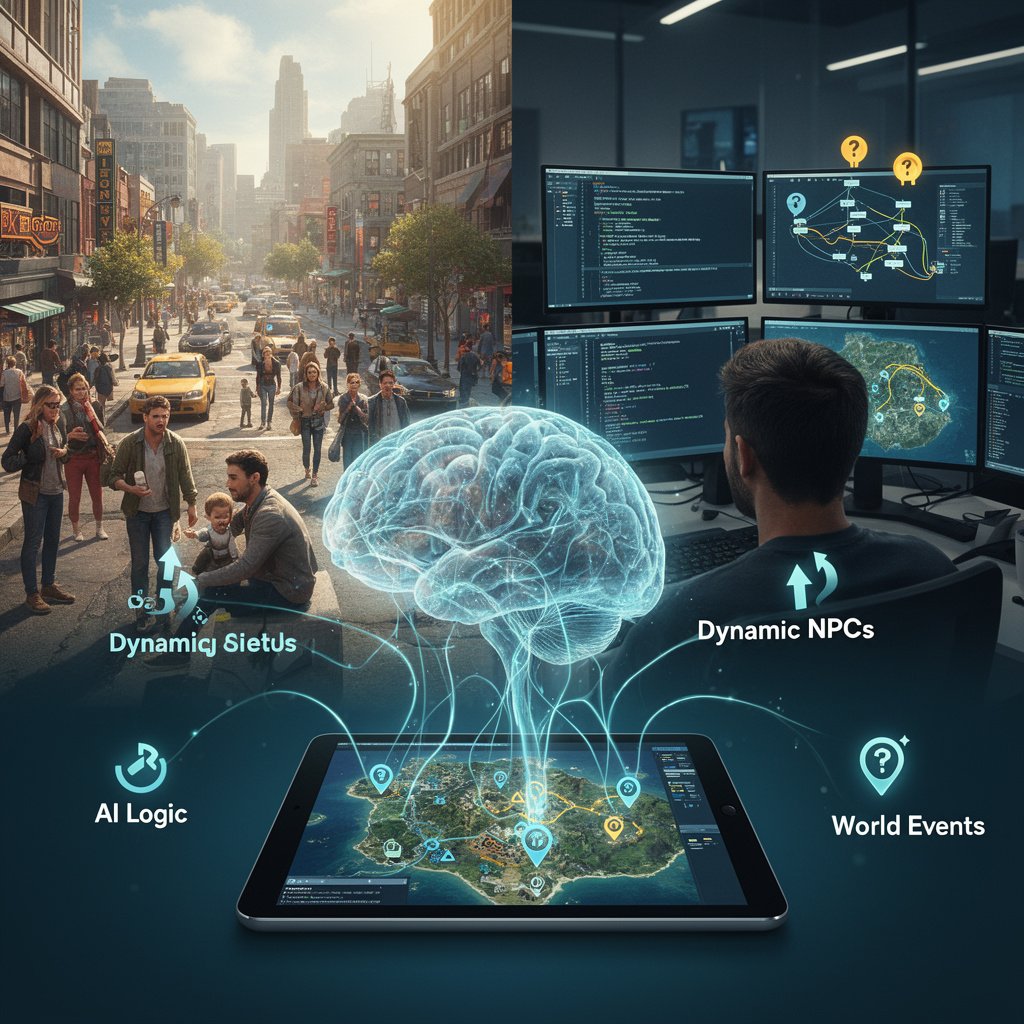
When people think about AI in games, they often picture enemy soldiers flanking their position or boss patterns to memorize. But open-world AI operates on a completely different scale. It’s less about individual encounters and more about simulating entire societies.
Consider what happens when you enter a city in a modern open-world game. Hundreds of NPCs go about their daily routines. Shopkeepers open their stores at dawn. Workers commute through the streets. Children play in parks during certain hours. Guards patrol neighborhoods with varying intensity based on crime rates you’ve influenced.
None of this requires your presence. The simulation runs continuously, creating a persistent world that feels genuine rather than staged.
This differs fundamentally from older game design, where NPCs existed only to serve player needs. They’d stand eternally at their posts, repeating identical dialogue, waiting for you to interact with them. Modern open-world AI treats inhabitants as autonomous agents with goals, schedules, and social relationships that exist independently of the player’s story.
How Modern Games Pull This Off
The technical approaches vary, but most sophisticated open-world games use layered AI systems working together.
Behavior trees handle individual decision-making. Think of these as flowcharts that help NPCs choose actions based on current conditions. Is it raining? Seek shelter. Is a predator nearby? Flee or fight depending on species. Is the player acting suspiciously? Become alert.
Navigation meshes solve movement challenges across complex terrain. Early open-world games suffered from NPCs walking into walls or getting stuck on geometry. Modern systems calculate pathfinding dynamically, allowing characters to traverse environments naturally—climbing obstacles, swimming through waterways, finding alternate routes when paths become blocked.
The real magic happens with systemic AI—emergent behaviors arising from multiple systems interacting. In games like The Legend of Zelda: Tears of the Kingdom, you witness this constantly. Lightning strikes a metal object held by an enemy, electrocuting nearby creatures, which drops a wooden weapon that catches fire from a campfire, spreading to dry grass. Nobody programmed that specific sequence. The systems just talk to each other.
Real Examples That Changed Everything
Certain games pushed open-world AI forward in ways that influenced the entire industry.
The Elder Scrolls series pioneered NPC scheduling back in 2006 with Oblivion. Characters had homes, jobs, and social connections. They’d visit friends, attend church services, and react to crimes they witnessed. Crude by today’s standards, but revolutionary then.
Red Dead Redemption 2 raised the bar dramatically. Wildlife follows realistic ecosystem rules—predators hunt prey, animals migrate seasonally, and populations respond to environmental changes. Human NPCs remember previous encounters. Insult someone in Valentine, and they might pick a fight weeks later when you return.
Assassin’s Creed games developed crowd AI to impressive degrees. Thousands of NPCs populate cities, reacting believably to events around them. Street performers draw crowds. Merchants argue with customers. Protests form and disperse based on political tensions within the game world.
Watch Dogs: Legion took a fascinating approach by making every single NPC recruitable with procedurally generated backstories, skills, and relationships. The AI simulates an entire population’s lives, allowing players to target anyone as a potential ally.
Where Open World AI Still Struggles
Honesty matters here. These systems, impressive as they’ve become, still show seams under scrutiny.
NPC memory remains frustratingly short in most games. Commit a crime in front of witnesses, hide for a few minutes, and society largely forgets. The “arrow in the knee” problem persists—NPCs often lack meaningful long-term memory of player actions beyond binary reputation meters.
Conversation AI lags far behind behavioral AI. While characters navigate complex worlds believably, their dialogue frequently loops or breaks immersion. You’ll hear the same guard make identical comments about the weather dozens of times.
Ecosystem simulations, while beautiful, often lack true consequence. Hunting a species to extinction rarely matters long-term. Economic systems don’t genuinely respond to supply disruption. The world feels alive in presentation but shallow when probed.
Resource constraints force compromises, too. Simulating thousands of fully autonomous agents demands processing power. Developers constantly balance detail against performance, often simplifying AI for characters outside the immediate player vicinity.
The Direction Things Are Heading
Recent technological advances suggest dramatic improvements coming within this console generation.
Machine learning integration allows NPCs to learn from player behavior rather than following static rules. Some experimental games feature enemies that adapt tactics based on how you’ve fought previously, creating genuinely dynamic challenges.
Natural language processing opens possibilities for dynamic conversations rather than pre-written dialogue trees. Imagine NPCs you can actually talk to, who understand context and respond appropriately. Early implementations already exist in indie projects.
Procedural narrative generation could eventually allow open-world games to create stories around player actions rather than forcing players through authored content. Your specific journey through a world would generate unique quests and character arcs.
Cloud computing might solve processing limitations by handling AI calculations remotely. Servers could simulate thousands of complex agents without taxing local hardware, enabling unprecedented population density and behavioral sophistication.
What This Means For Players
Better open world AI ultimately serves immersion and emergent gameplay—two things that keep players returning for hundreds of hours.
When worlds feel genuinely alive, exploration becomes intrinsically rewarding. You discover unexpected moments rather than consuming scripted content. Stories emerge from systemic interactions that feel personal because they arose from your specific choices and timing.
Is that a deer drinking from the stream? It meant something because the world didn’t arrange it for me. I witnessed it because I happened to be there when the simulation produced that moment. Nobody else experienced exactly what I saw.
That’s the promise of AI in open-world games—not just bigger maps or more activities, but worlds that justify their existence whether we’re watching or not.
Frequently Asked Questions
What does AI actually do in open-world games?
It controls NPC behavior, wildlife ecosystems, crowd dynamics, pathfinding, and systemic interactions that make game worlds feel alive and responsive.
Which open-world game has the best AI?
Red Dead Redemption 2 is widely considered the current benchmark for wildlife and NPC behavior, though The Legend of Zelda series excels at emergent systemic gameplay.
Why do NPCs still act stupidly sometimes?
Processing limitations force developers to simplify AI for non-essential characters. Balancing complexity against performance remains a fundamental challenge.
Will future games have NPCs you can really talk to?
Natural language processing is advancing rapidly, and experimental games already feature basic conversational AI. Widespread implementation likely arrives within the next few years.
Does AI impact open-world game performance?
Yes, complex AI simulations require significant processing power, which is why many games reduce AI complexity for distant characters or crowded scenes.
How does enemy AI differ from world simulation AI?
Enemy AI focuses on combat behaviors and player opposition, while world simulation AI creates believable environments through NPC routines, ecosystems, and social systems.