
Last summer, I spent an embarrassing number of hours watching virtual citizens in Cities: Skylines 2 commute to work. Not playing, really just observing. Each simulated person had a home, a job, preferred routes. Traffic patterns emerged organically from thousands of individual decisions. Something about watching that complexity unfold from simple rules felt almost magical.
That fascination has shaped much of my gaming experience over the years. From watching ecosystem dynamics in Dwarf Fortress to marveling at emergent behaviors in strategy games, AI simulations have become the invisible backbone of truly immersive gaming experiences.
What AI Simulations Actually Mean for Games

When we talk about AI simulations in gaming, we’re describing systems that model complex behaviors, environments, or processes without scripting every outcome. Rather than programming specific events, developers create rules and let the simulation run. Results emerge naturally – sometimes predictably, often surprisingly.
This differs fundamentally from traditional game design. Old school approaches might script specific enemy patrols, predetermined weather patterns, or fixed economic cycles. Simulations instead establish underlying systems that generate these elements dynamically.
The distinction matters because simulations create possibility spaces. Players encounter situations developers never explicitly designed. That unpredictability keeps games fresh across multiple playthroughs and enables experiences that feel genuinely alive.
The Many Faces of Gaming Simulation
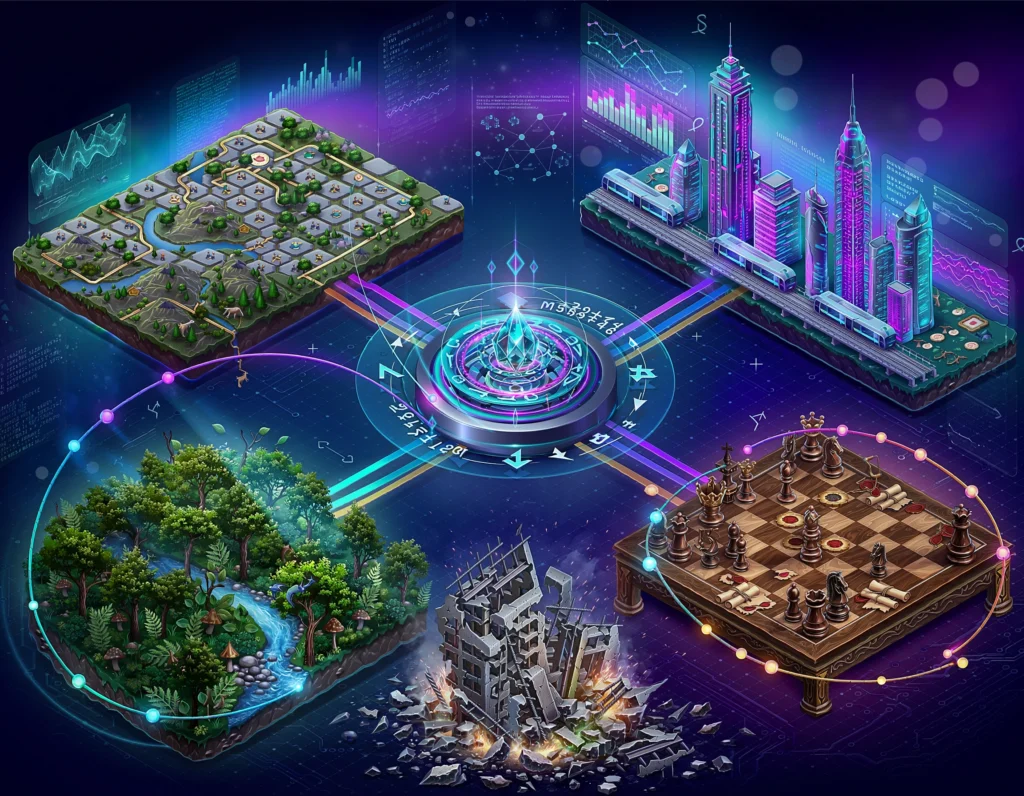
AI simulations manifest differently across genres, each leveraging the technology for distinct purposes.
Ecosystem and World Simulations
Games like Rimworld and Dwarf Fortress simulate entire ecosystems. Animals hunt prey, weather affects crop growth, diseases spread through populations. These interconnected systems create cascading consequences that generate emergent narratives.
I remember a Rimworld colony where a toxic fallout event killed local wildlife. Without animals to hunt, my colonists faced food shortages. Desperation led to risky expeditions that resulted in injuries. The medical crisis that followed wasn’t scripted it emerged from simulation layers interacting unexpectedly.
Economic Simulations
Strategy games increasingly model realistic economies. Victoria 3 simulates global trade, supply chains, and market dynamics. Price fluctuations reflect actual supply and demand rather than arbitrary formulas.
This complexity enables meaningful strategic decisions. Controlling rubber production matters because the simulation accurately models industrial dependencies. Decisions ripple through interconnected systems in ways that feel consequential.
Social and Political Simulations
Crusader Kings 3 simulates medieval social dynamics with remarkable depth. Characters have personalities, form relationships, hold grudges, and pursue ambitions. Political intrigue emerges from thousands of simulated interactions rather than scripted events.
The result feels genuinely unpredictable. My carefully planned succession might collapse because a vassal developed an unexpected rivalry with my heir. These emergent complications create memorable stories unique to each playthrough.
Physics and Environmental Simulations
Games like BeamNG.drive simulate vehicle physics with incredible accuracy. Each component suspension, chassis, engine behaves according to physical principles. Crashes produce unique damage patterns because the simulation calculates forces realistically rather than playing canned animations.
This approach extends beyond vehicles. Teardown simulates structural integrity, allowing buildings to collapse realistically when supports are destroyed. Noita simulates individual pixels with physical properties, creating chain reactions that surprise even developers.
Why This Matters for Players
The appeal of well designed simulations extends beyond technical impressiveness.
Replayability improves dramatically. When outcomes emerge from simulation rather than scripts, each playthrough genuinely differs. The third time through a simulated strategy game reveals new possibilities because circumstances evolved differently.
Agency feels more meaningful. Decisions matter when systems respond realistically. Building a factory upstream affects downstream water quality. Overhunting depletes animal populations. Cause and effect relationships make choices consequential.
Discovery becomes ongoing. Players uncover simulation interactions long after initial release. Communities share findings, experiment with edge cases, and develop strategies exploiting system interactions. The game remains engaging because the simulation contains unexplored depth.
The Development Challenges Nobody Mentions
Creating compelling AI simulations presents difficulties that explain why many developers avoid them.
Balancing complexity against performance remains constant tension. Every simulated element consumes processing power. Developers must decide which systems warrant simulation depth and which can use simpler approximations. These tradeoffs involve painful compromises.
Debugging emergent systems proves nightmarish. When problems arise from interaction between multiple systems, identifying root causes becomes detective work. A bug might only manifest under specific simulation conditions that occur rarely.
Player communication challenges emerge too. Simulation systems often remain invisible. Players might not understand why certain outcomes occurred or how their actions influenced results. Without proper feedback, sophisticated simulations feel arbitrary rather than meaningful.
Testing coverage becomes nearly impossible. With astronomical possible states, testing can’t cover every scenario. Developers rely on automated testing and community feedback to identify problems that slip through.
Current Trends Shaping the Field
Several developments are expanding what’s possible in gaming simulations.
Machine learning techniques increasingly supplement traditional simulation approaches. Neural networks can model complex behaviors that would be impractical to simulate explicitly. Character movement, crowd dynamics, and decision-making benefit from these hybrid approaches.
Cloud computing enables simulations beyond local hardware capabilities. Some developers explore server-side simulation for massively complex systems, streaming results to players rather than calculating locally.
Procedural generation combines with simulation to create unique worlds that function according to consistent rules. Each generated environment behaves realistically because underlying simulations remain constant even as geography changes.
Looking Forward
The trajectory points toward increasingly sophisticated simulations becoming standard rather than exceptional. As hardware improves and techniques mature, expectations rise accordingly.
What excites me most is the potential for emergent storytelling. Games that simulate enough social, political, and environmental complexity might generate narratives rivaling authored content but completely unique to each player’s experience.
The technical challenges remain substantial. But watching how far simulations have come since simple cellular automata, it’s difficult not to feel optimistic about where they’re heading.
For players, this evolution means richer worlds that respond meaningfully to our presence. For developers, it means tools that generate endless content from elegant systems. And for the medium overall, it represents another step toward games that feel genuinely alive.
Frequently Asked Questions
What’s the difference between AI simulation and regular game AI?
Traditional AI follows scripted behaviors for specific situations. AI simulations model underlying systems that generate behaviors emergently, creating unpredictable and dynamic outcomes.
Which games best showcase AI simulation technology?
Dwarf Fortress, Rimworld, Crusader Kings 3, Victoria 3, and BeamNG.drive demonstrate sophisticated simulations across different genres and applications.
Do AI simulations require powerful hardware?
Complex simulations are computationally demanding, though developers optimize extensively. Many simulation heavy games offer settings to adjust simulation detail based on hardware capabilities.
Can AI simulations replace traditional game design?
Simulations complement rather than replace traditional design. Most games blend simulated systems with authored content, using each approach where it works best.
Why don’t all games use detailed simulations?
Development complexity, performance requirements, and design priorities influence these decisions. Some games benefit more from tight authored experiences than emergent simulation outcomes.