I’ve been gaming for nearly two decades, and I’ve watched the industry evolve in ways that seemed purely theoretical just five years ago. Today, we’re standing at an inflection point where artificial intelligence isn’t just a supporting tool in game development it’s fundamentally reshaping how entire worlds are created, populated, and experienced. What was once the domain of large teams of artists, designers, and programmers working for months can now be jumpstarted by AI systems that generate environments, narratives, and gameplay elements in hours.
But here’s the thing: this shift is far more nuanced than the hype suggests. It’s not about AI replacing human creativity. Rather, it’s opening up possibilities that were previously locked behind massive budgets and studio resources.
How AI Actually Creates Game Worlds
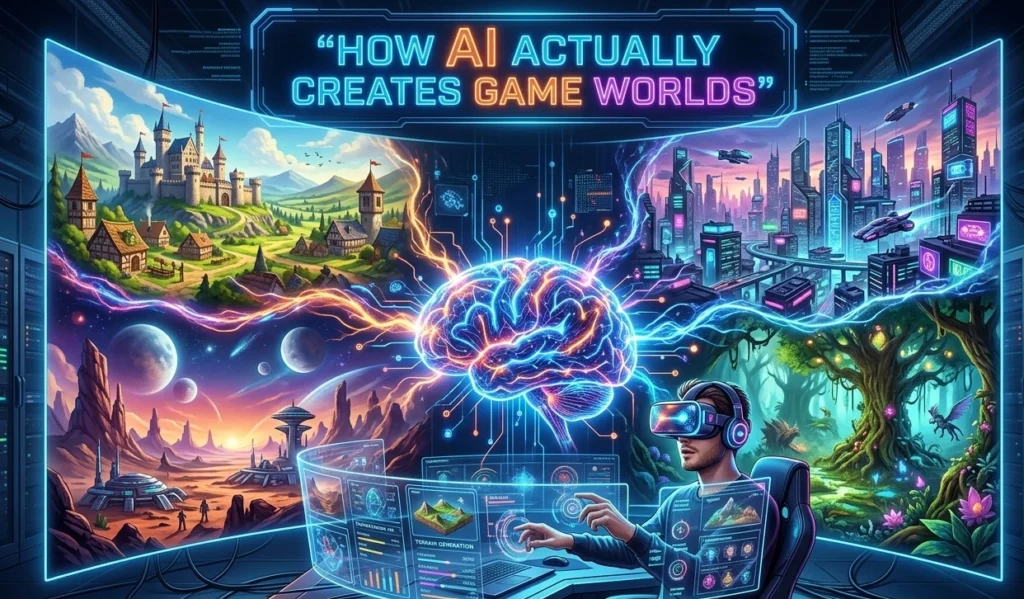
When we talk about AI generated game worlds, we’re usually referring to several overlapping technologies. The most visible is procedural generation using neural networks systems trained on thousands of existing game assets, architectural styles, and environmental designs that can synthesize new variations that feel both familiar and fresh.
I first saw this in action with a smaller indie project exploring dungeon generation. Instead of hand crafting every cave system and treasure room, developers fed the AI reference materials from classic games. The system learned patterns: how corridors typically branch, where enemies feel naturally positioned, how lighting creates atmosphere. Within minutes, it generated dozens of entirely original dungeon layouts that actual playtesters found engaging and intuitive. No single one was better than what a human designer might create, but the volume was striking.
The process usually works like this: artists and designers establish parameters and constraints, then let the AI work within those boundaries. A developer might say, “Create a forest environment with ancient ruins, 40% vegetation density, mystical lighting, suitable for a level 15-20 adventure.” The AI doesn’t just copy existing forests it understands the conceptual elements and synthesizes something new.
What’s crucial to understand is that this isn’t magic. The AI has no consciousness or genuine creativity. It’s performing sophisticated pattern matching and interpolation. But that capability, even without consciousness, is genuinely useful.
The Real World Applications
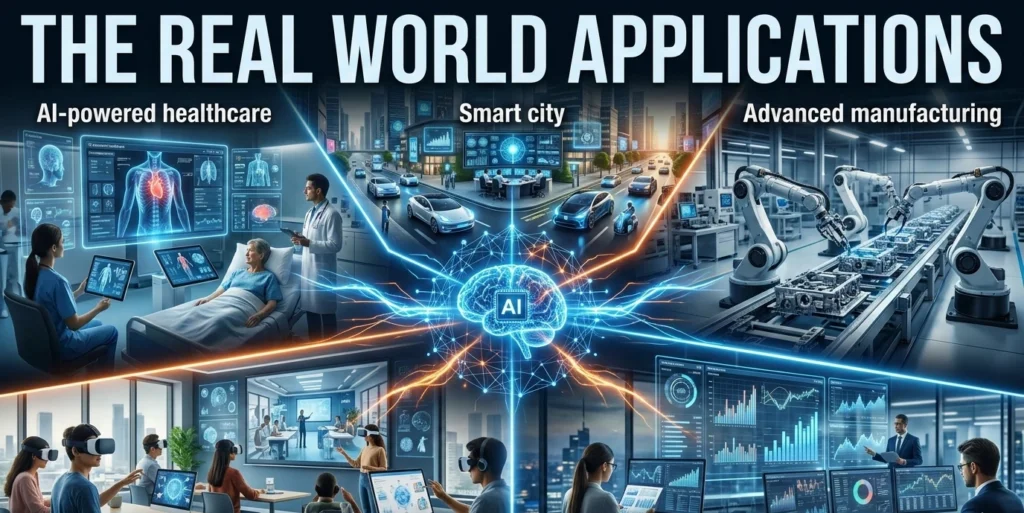
Several studios are already shipping games with meaningful AI generated content. Spore, which debuted in 2008, used procedural generation, though not neural networks. More recently, games like No Man’s Sky create billions of procedurally generated planets, each with unique characteristics. While No Man’s Sky primarily uses rule based procedural systems rather than neural AI, newer projects are integrating actual machine learning.
I spoke with a developer at a mid sized studio working on an action RPG who told me they used AI to generate 200 unique NPC dialogue variations based on a single script. Rather than having every vendor repeat identical lines, the system created subtle personality variations different word choices, speech patterns, emotional undertones. Players never consciously notice, but the world feels less repetitive. That’s a practical win.
The economics matter here. Smaller studios without massive art departments can now prototype environments at speeds previously impossible. A solo developer or a team of three can generate basic environmental assets that a single artist would take months to produce. This democratization is real and meaningful.
But there’s a shadow side. Some studios are using AI generation as a shortcut to avoid hiring actual artists rather than as a tool to augment their work. The results are often visually sterile technically competent but emotionally empty. Procedurally generated grass doesn’t have the intentional placement that makes a landscape feel alive.
The Quality Question
This is where I have to be honest: AI generated content is a mixed bag. I’ve played games where procedural environments created by AI felt genuinely immersive. I’ve also played games where the lack of human artistic intent was immediately apparent. Everything was technically correct, nothing was actually beautiful.
The issue is that good game design isn’t just about aesthetics it’s about intention. When a talented artist places a bench in a specific location with a particular angle, they’re telling a subtle story. That bench might be facing a vista, inviting contemplation. Or positioned defensively, suggesting caution. AI doesn’t understand these narratives. It understands statistical distributions of where benches appear in training data.
The best implementations I’ve seen treat AI as the first draft. Human designers then go through and add intention, remove sterile sections, create meaningful focal points. That hybrid approach works. Pure AI generation without human refinement often feels hollow.
Narrative and Storytelling
Where things get more complicated is narrative generation. Several research teams are exploring AI systems that can generate quest structures, dialogue, and story branches. Theoretically, this could allow for infinite storylines rather than the branching path limitations of traditional narrative games.
In practice, most AI generated narratives are either technically limited (producing simple, linear stories with minimal emotional resonance) or hallucinate absurd content (NPCs making non sequiturs, quest logic breaking down). The technology is advancing rapidly, but we’re not yet at a point where AI generated narratives match human written stories in emotional impact or coherence.
There’s also something philosophically interesting happening here. Games like AI Dungeon explicitly show the AI process to the player the game is about collaborating with an AI storyteller, with all its weird tangents and surprising turns. That’s honest about the technology’s current limitations while turning them into a feature rather than a bug.
Ethical Considerations and Industry Impact
The AI game world conversation raises legitimate concerns. Training these systems requires feeding them thousands of existing game assets, many of which are copyrighted works. Studios developing these tools are sometimes operating in legal gray areas. The compensation for original creators whose work trained the AI is essentially nil.
There’s also the labor question. If AI can generate environments that previously required three artists six months to create, what happens to those artists? Some will transition to refining and directing AI output. Some will move into higher level creative roles. But the disruption is real, and dismissing those concerns as technophobia misses the legitimate economic anxiety.
From my perspective, this technology is neither purely beneficial nor purely harmful. It’s a tool with real capabilities and real limitations, entering an industry with real people whose livelihoods depend on creative work.
Where This Actually Goes
The future is probably less “AI replaces game developers” and more “AI becomes another tool in the development kit.” The studios doing interesting work aren’t the ones trying to automate game development. They’re the ones using AI to handle repetitive tasks so humans can focus on higher order creative decisions.
Games developed entirely by AI without human creative direction will likely exist as a niche category interesting experiments, not mainstream experiences. The best games will probably come from teams that understand both AI’s genuine strengths (rapid prototyping, variation generation, pattern recognition) and its authentic limitations (lack of emotional understanding, potential for sterility, need for human refinement).
The technology is real, it’s advancing, and it’s already affecting the industry. The question isn’t whether it will matter. The question is how we integrate it thoughtfully.
FAQs
Q: Can AI completely replace human game designers?
A: Not currently, and probably not in the foreseeable future. AI excels at generating variations and rapid prototyping but lacks the intentional creative vision that makes games emotionally resonant. The best outcomes use AI as a tool that humans guide.
Q: Are AI generated games already on the market?
A: Not as complete, standalone games. However, AI is already generating specific elements (textures, dialogue, environments) in several published titles. The technology is integrated into production pipelines, not replacing the entire process.
Q: Will this put game developers out of work?
A: It will likely shift the types of work available. Artists may focus more on creative direction and refinement rather than asset production. Some roles may diminish, but the overall demand for creative talent in gaming likely continues growing as development becomes faster and easier.
Q: What’s the copyright status of AI generated game content?
A: This remains legally unclear in many jurisdictions. It depends on how the AI was trained, what jurisdiction you’re in, and the specific terms of use. It’s an active legal area with ongoing disputes.
Q: Can AI generated worlds feel as engaging as human designed ones?
A: They can, but usually with human refinement and creative direction. Pure AI generation often lacks the intentionality that makes spaces feel purposeful and alive.